Cumulative Reading

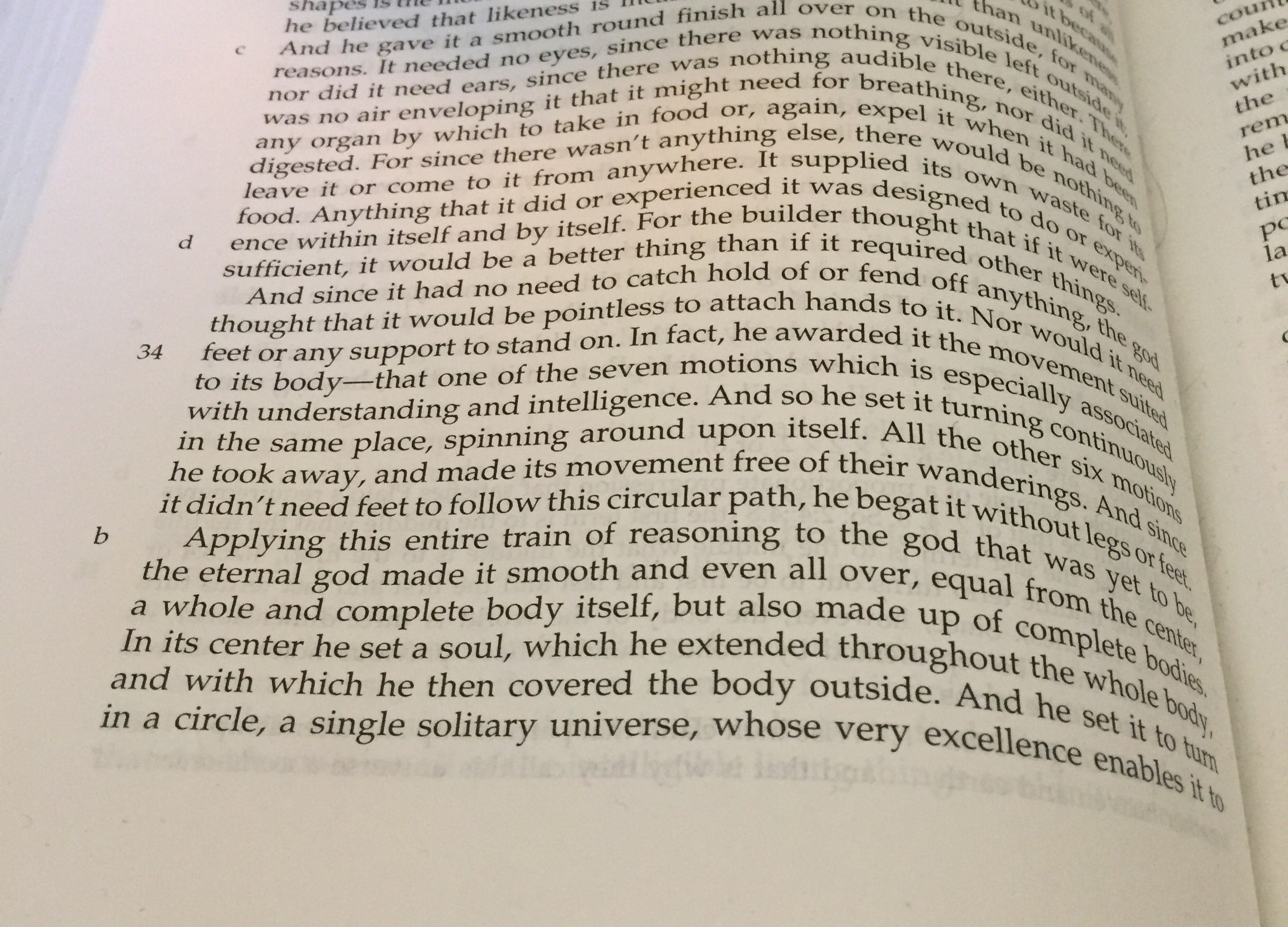
Reading L.P. Gerson’s God and Greek Philosophy, I came to a sentence beginning, “It is true that Plato calls the world made by this god a god as well (34b8), but . . .” And the sentence continues after that for three lines of text not important here. I suppose I wanted to get a sense of how loose or faithful the word “god” was to the original text, so, remembering the Complete Works of Plato on my shelf, I decided to make use of the Stephanus number provided and find the passage in the Timaeus that was being cited. I parted the leaves of the book and, finding the correct page, read as follows:
And since it had no need to catch hold of or fend off anything, the god thought that it would be pointless to attach hands to it. Nor would it need feet or any support to stand on. In fact, he awarded it the movement suited to its body—that one of the seven motions which is especially associated with understanding and intelligence. And so he set it turning continuously in the same place, spinning around upon itself. All the other six motions he took away, and made its movements free of their wanderings. And since it didn’t need feet to follow this circular path, he begat it without legs or feet.
Applying this entire train of reasoning to the god that was yet to be, the eternal god made it smooth and even all over, equal from the center, a whole and complete body itself, but also made up of complete bodies. In its center he set a soul, which he extended throughout the whole body, and with which he then covered the body outside. And he set it to turn in a circle, a single, solitary universe, whose very excellence enables it to keep its own company without requiring anything else. For its knowledge of and friendship with itself is enough. All this, then, explains why this world which he begat for himself is a blessed god.
(From the translation of Donald J. Zeyl.)
People often talk as if thought is a series of linguistic propositions, or else a stream-of-consciousness narrative in the head. I think that’s a very narrow view, but anyway, what I first experienced on reading this passage (that is, re-reading it after a gap of many years) was not thought in this sense; it was more like a sensation of mental space, of the mind breathing expansively. I felt myself suspended amidst the revolving spheres of a meaningful universe. I felt the profundity of the calm and sonorous voice of a dead soul; a voice somehow intelligible to a mind separated from it by millenia.
Slowly the planets that revolved in my mind began to assume names. I saw in these two short paragraphs a number of momentous precursors and also some significant descendants, and I was aware of numerous planets revolving that I could not name.
Of the predecessors whose presence was visible here, I thought of Anaxagoras (nous—the cosmic mind—and the circular motion this causes), Parmenides (for whom Being was like a perfect, “well-rounded” globe), and Xenophanes (to whose ‘one god’ the world soul described above is similar in being non-anthropomorphic and fixed in place, though the world soul, or the world of which it is a soul, has circular motion).
Of the descendants, I thought of Aristotle, of course (Plato’s pupil, whose cosmology also takes up this idea of the perfection of circular motion), the Mediaevals (for whom the Timaeus was one of the great cosmological texts, and who were also much indebted to Plato via Aristotle), and even of Gottlob Frege (though at the time of writing this, that presence is not so plain to me; I know I detected Frege’s Third Realm there, and perhaps saw this in the idea of the world soul; perhaps I was mistaken).
As I reflected further, it came to me that this ability to see, or feel, at least some of the great depth in Plato’s writing, was the result, to an important degree, of other reading. If I had picked up the Timaeus and read those same two paragraphs twenty years ago, what would I have made of them? I can hardly say. But by almost indiscernible increments, reading year after year has made this kind of difference.
I knew that this was of great value to me but wondered how I might be able to convey it to someone else. Philosophy and the humanities seem to be losing their grip on the human imagination in the current age, perhaps because people do not have the patience for such slow results, but also because those results come in forms much harder to demonstrate on the spot to an expectant audience. I remembered, then, a series of tweets that Richard Dawkins had made about Plato. This was the main one:
Surprised by common reverence for Plato. Alexandrians like Eratosthenes made superb progress. But what did Plato say that was actually right? And didn’t he mislead generations of theologians & philosophers into thinking you could find truth by making stuff up in an armchair?
Because of recent reading, I am also able to see a notable precursor here. This reads to me like a crass echo of Francis Bacon’s excoriation of Scholastic metaphysics. (I am coming to believe that Bacon and the British empiricism that followed, in turning away so radically from metaphysics, have a great deal to answer for.)
The assumption behind the first question is exasperating. It’s all too clear that one can find plenty of things about which Plato was right if one doesn’t somehow believe it goes without saying that ‘right’ means ‘right with reference to the findings of contemporary physics, chemistry and biology’. That a person has narrow interests, one can allow for. That a person is continually affronted that not everyone is as narrow as he is becomes extremely wearisome. But before I return to Dawkins’s first peevish question, let me look at the second one: “didn’t he mislead generations of theologians & philosophers into thinking you could find truth by making stuff up in an armchair?” The Socratic method, which Plato followed and made famous, would not have led to the trial of Socrates, and his drinking the cup of hemlock under sentence of death, if he had merely sat in an armchair making stuff up. But for Dawkins, it would seem, knowledge is merely about knowing the right facts (getting it right) within a certain restricted domain, and the process of enquiry, the analysis of concepts, the excavating of assumptions by the use of aporia (an impasse caused by conceptual dilemmas, trilemmas, and so on), which awakes a person to the fact he has been operating unthinkingly with received ideas, the motivation of philosophy by the eros for truth, the flight of the soul to the divine source of ultimate understanding in which goodness, truth and beauty unite—all this is nothing because Plato thought that vision resulted from particles shooting out of the eyes and not from light entering them. It’s as if someone read David Copperfield and all they could think of to say was, “There’s no real evidence for spontaneous combustion, you know.”
I am also amazed that it does not occur to Dawkins that two thousand years before the Scientific Revolution, in Ancient Greece, there might have been other ways of thinking and expressing oneself than in the literalistic academese of the twentieth and twenty-first centuries. Plato’s allegory of the Cave is not called an allegory for nothing. But perhaps we should not expect too much literary sophistication from a man who criticised Kafka’s ‘Metamorphosis’ for being neither allegory nor science fiction.
I could indulge my irritation at great length, but my legs are starting to go numb and there are other things to do, so I will attempt to move towards a conclusion. I don’t even need to go outside of Dawkins’s implied narrow parameters to find an answer to the question he seemed to intend as rhetorical. What did Plato get right according to the current consensus of the physical sciences? I quote now from Paul Friedländer’s Plato: An Introduction, Chapter XIV: Plato as Physicist, which largely deals with the content of the Timaeus:
Let us now consider the form of these corpuscles or, as we may provisionally call them, atoms. In the atomism of Leukippos and Demokritos, the atoms have an indefinite number of different shapes, more or less irregular, with all sorts of corners, hooks, bulges, and holes. When they are round they need not be spherical; when they have corners they need not have any regular form. There may be spheres or cubes among them, but only by chance. Plato radically transformed the atomism of the Abderites. He took a step of the greatest importance, though it is not mentioned in the standard histories of the natural sciences and is misjudged even by Heiberg, an authoritative historian of ancient thought. In the Timaeus there are only four kinds of corpuscles, each element having its particular atomic structure. These four kinds have stereometrical forms: they are regular pyramids, cubes, octahedra, and icosahedra, four of the five regular solids that still bear the name of Platonic polyhedra. The fire corpuscle is a pyramid, the earth corpuscle a cube, the air corpuscle an octahedron, the water corpuscle an icosahedron. This mathematical construction is fantastic, but much less so than the more naturalistic one of classical atomism. For, granted that the details are fantastic, a truly fundamental idea is established by this construction: the order on the lowest recognizable level of nature accounts for the order on its higher and highest levels. Not chance but reason have shaped the building stones of the universe; they have mathematical form.
Plato, consequently, more nearly anticipates modern physics and chemistry than do the atomists. Today the molecule of methane gas . . . is visualized spatially as a regular pyramid with four hydrogen atoms at its four corners and a carbon atom in the center.
Et cetera.
Something else that comes with accumulated reading, then, is that from time to time one is able to clock a public figure, known as an expert at something or other, supposedly strutting their stuff, and to see very well that they are talking out of their hat.
Thank you for this, Quentin. Your reflections are of a sort that makes one -- or at least this one -- feel seen.